《114-2_GHRM651》Visiting Scholar from Bayes Business School Shares Insights on Strategy and Market Legitimacy
/Written by Sandy Yang, Teaching Assistant, IBMBA
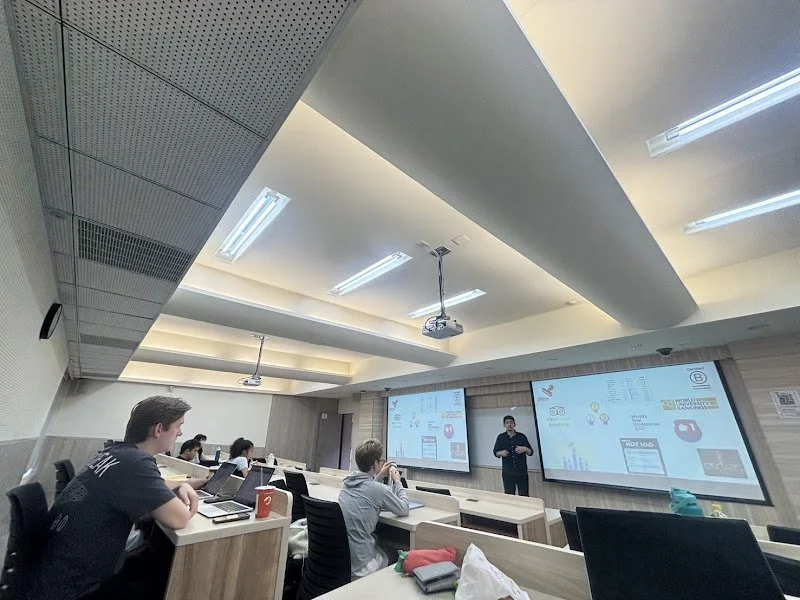
The program recently welcomed a visiting assistant professor from Bayes Business School (formerly Cass Business School), University of London, for a guest lecture on strategic positioning and the psychology of category legitimacy. With a PhD in strategic management from HEC Paris and an interdisciplinary background in sociology and philosophy, the professor discussed how market categories, such as industry segments, shape firms' competitive positioning and strategic choices.
The professor began by exploring the foundational concept of market categories, explaining that they act as "judgment devices" that reduce complexity, guide attention, and stabilize evaluation in markets. Using familiar examples, he illustrated how companies span different organizational forms, such as Netflix acting as both a streaming platform and a production studio, or Amazon expanding from a bookseller to a dominant player in web services (AWS). He emphasized the importance of understanding categorical boundaries, noting that spanning too many categories can sometimes confuse consumers or investors, leading to lower evaluations due to a lack of clear identity.
A central theme of the lecture was "optimal distinctiveness," which addresses the strategic tension between conformity and differentiation. The professor introduced the two-stage valuation model, explaining that candidates or products must first conform to market expectations to secure audience attention within a "zone of legitimacy" before differentiating themselves to be selected. Citing a comprehensive study of 27,000 Billboard hit songs over 60 years, he highlighted that the most successful songs are positioned in the middle—differentiating enough to gain appeal without straying too far from the genre's typical features.
Toward the end of the session, the discussion shifted to category life cycles and the necessity of adapting to technological shifts, using examples like the transition from CDs to Spotify, and the shift from rim brakes to disc brakes in cycling. The professor also discussed the role of social status, explaining that middle-status organizations are most likely to conform to acquire legitimacy, whereas high-status actors have the freedom to differentiate because their membership is already proven.
The professor’s lecture offered students a profound understanding that competitive strategy is not just about being different, but about orchestrating both conformity and differentiation. It invited students to consider category legitimacy not merely as an academic concept, but as a crucial tool for gaining a long-term competitive advantage in dynamic global markets.